

The New Structure of Industry
Every industrial era was defined by who owned its operating structure. This one is being decided inside your software contracts.
Every era of industry has had a structure. The factory system had one. The multidivisional corporation had one. The globalized supply chain had one. In each case, the structure — how work, capital, information, and decision-making were wired together — mattered more than any single machine inside it. The companies that understood this owned the structure. The companies that didn't rented pieces of it and wondered why the returns never compounded.
The AI era has a structure too. It is being decided right now. And most brands are signing it away one SaaS contract at a time.
The pattern everyone recognizes and nobody names
Here is what the last three years have looked like inside most commerce operations. A capable team identifies a real problem. A vendor appears with an AI-flavored point solution that addresses exactly that problem. A pilot runs. The demo is impressive. A license is signed. Then a second problem surfaces, and a second vendor, and a second license. Within eighteen months the operation is carrying a dozen AI subscriptions, each one individually defensible, and the P&L shows the cost clearly while the value shows up nowhere anyone can point to.
The standard diagnosis is that the tools underdelivered. The tools mostly did what they said. The failure is structural: the value was never in the tools. It is in the layer that connects tools, data, context, and workflow into a single accountable operation — the orchestration layer. And that layer is the one thing licensed software structurally cannot sell you, because it is specific to your data, your processes, and your economics. A vendor can rent you a component. Nobody can rent you an operating model, because an operating model is, by definition, yours.
That is the sentence the industry has been circling for three years without landing on. You can't license an operating model. You can only build one — or go without.
What actually got transferred
The pitch behind every enterprise SaaS contract is risk transfer. Let us run this capability so you don't have to build it. Let us carry the engineering burden, the model updates, the uptime. It sounds like the buyer is shedding risk.
Look at what actually moved. The operational risk stayed exactly where it was — if the recommendations are wrong, the media is wasted, the inventory misallocated, the customer mispriced, it is still your P&L that bleeds. What transferred was control: over the logic, over the data that trains it, over the roadmap, over the price of continuing. The risk was never transferred. Only the control was.
Multiply that across a dozen contracts and the shape of the problem becomes visible. A brand can reach a point where it no longer runs its own commerce operation in any meaningful sense — it rents the operation back from its vendors, on terms it does not set, through interfaces it does not control, producing numbers it cannot reconcile to its bank account.
Rent the tools. Own the orchestration.
The answer is not to build everything. That is the opposite error, and it fails for the opposite reason: no brand should be in the business of maintaining commodity capability that the market supplies better and cheaper every quarter.
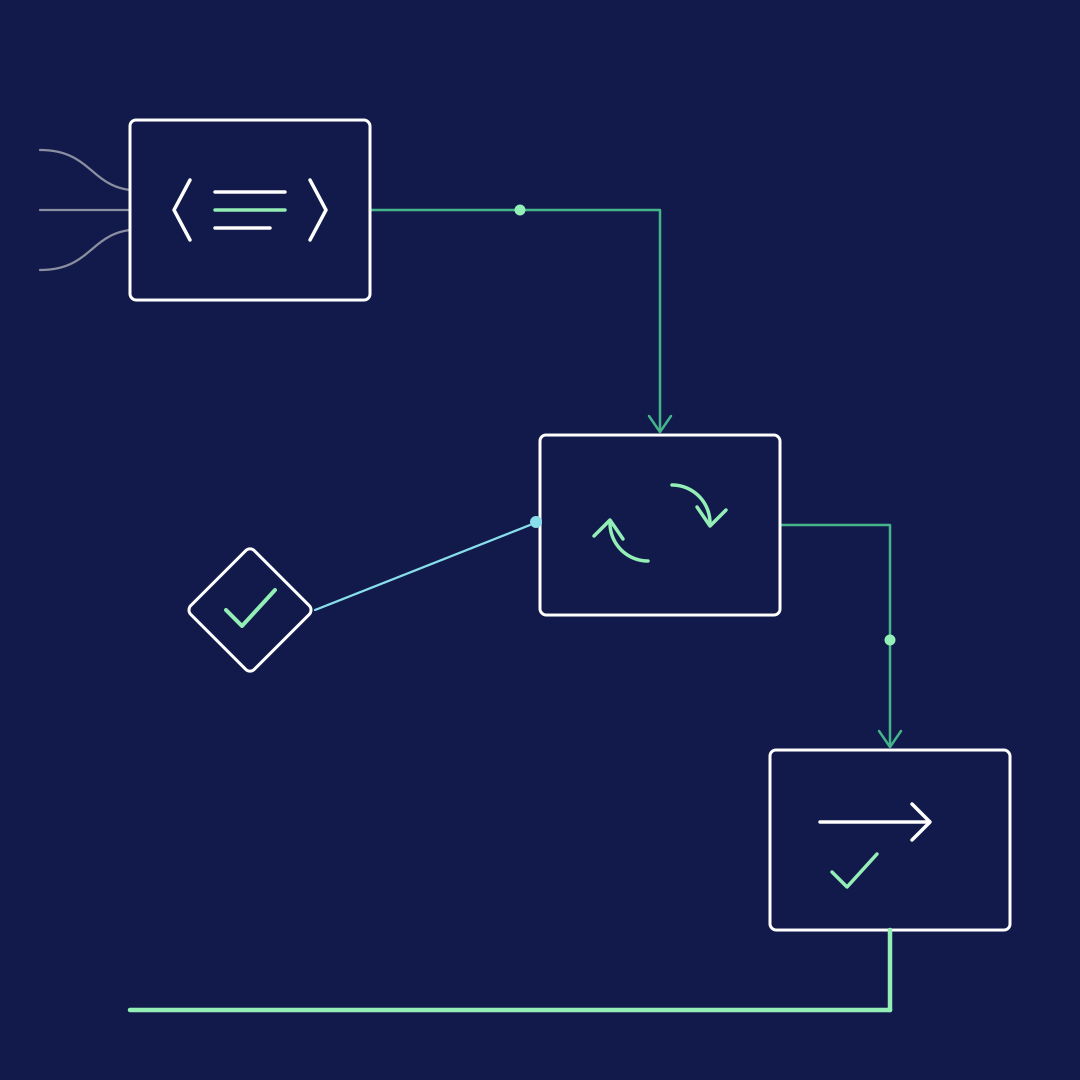
The answer is a boundary, drawn deliberately. Rent the tools — the models, the point capabilities, the infrastructure that improves on someone else's R&D budget. Own the orchestration — the layer where tools, data, context, and workflow are wired into one operation; where every investment enters with a forecasted cost and a defined success rule; where results are measured against financial ground truth rather than each vendor's own scoreboard.
Components on that side of the boundary should be interchangeable, competitive, and disposable. Everything on the ownership side compounds: the data gets richer, the workflows get sharper, the measurement gets more precise, and none of it walks out the door when a contract ends. That is what an asset is. A subscription is not one.
Why this is the structure of the next decade
Two forces make this arrangement permanent rather than cyclical.
The first is that AI has collapsed the cost of the orchestration layer itself. A decade ago, building a bespoke operating system for a commerce operation was a nine-figure enterprise-IT undertaking, which is precisely why everyone rented instead. That constraint is gone. The connective layer — agents, pipelines, decision logic bound to your own data — is now buildable at a cost that makes ownership rational for brands far below the Fortune 500.
The second is that the buyers are changing. Commerce is beginning to face machine buyers — agents that read catalogs, compare offers, and transact without a human in the session. Serving that future requires an operation whose data, logic, and interfaces you control end to end. A stack of rented point solutions, each with its own data silo and its own idea of the truth, cannot present a coherent face to a machine. An owned operating model can.
The brands that win the next decade will own their operating model. The ones that don't will rent it — and the difference will read directly in the margin structure, the way it always has when an industry re-sorts itself around a new structure.
The honest version of the boundary
One thing should be said plainly, because it is the part most firms in this space blur. When Pareto builds an operating model, the client owns the instance — the data, the data infrastructure, the configuration of their operation. Outright, stated in every proposal. Pareto retains its methodology and patterns, the way any professional firm does. That is the whole boundary, and it is the opposite of the arrangement described above: you are never renting your own operation back from us.
Technology changes. Math doesn't. The math of this era says the orchestration layer is where the value concentrates — and that whoever owns it, owns the operation.
Own it.